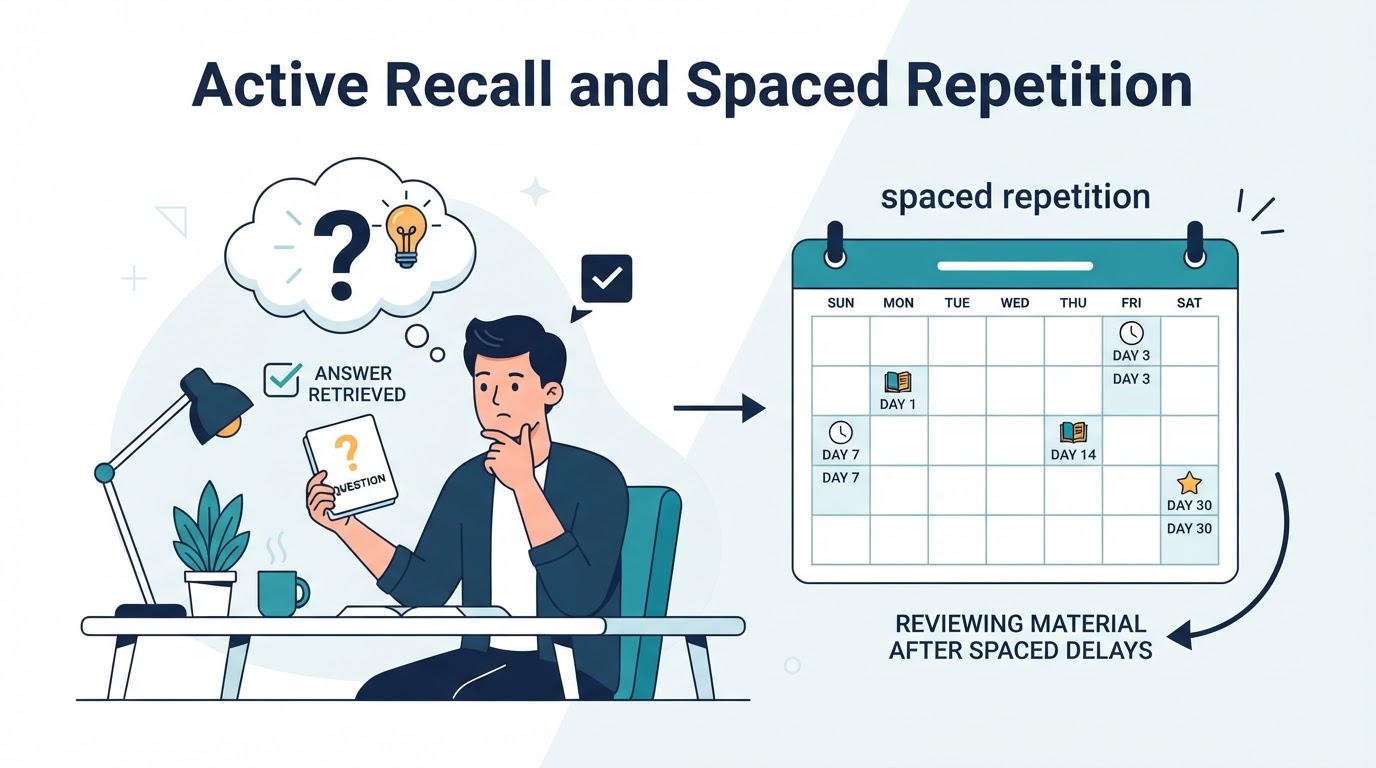
Active recall and spaced repetition address different parts of studying. Active recall is what you do during a review: produce an answer, explanation, solution, or procedure from memory before checking the source. Spaced repetition is how you distribute reviews: return to the material across separate sessions instead of concentrating everything in one sitting.
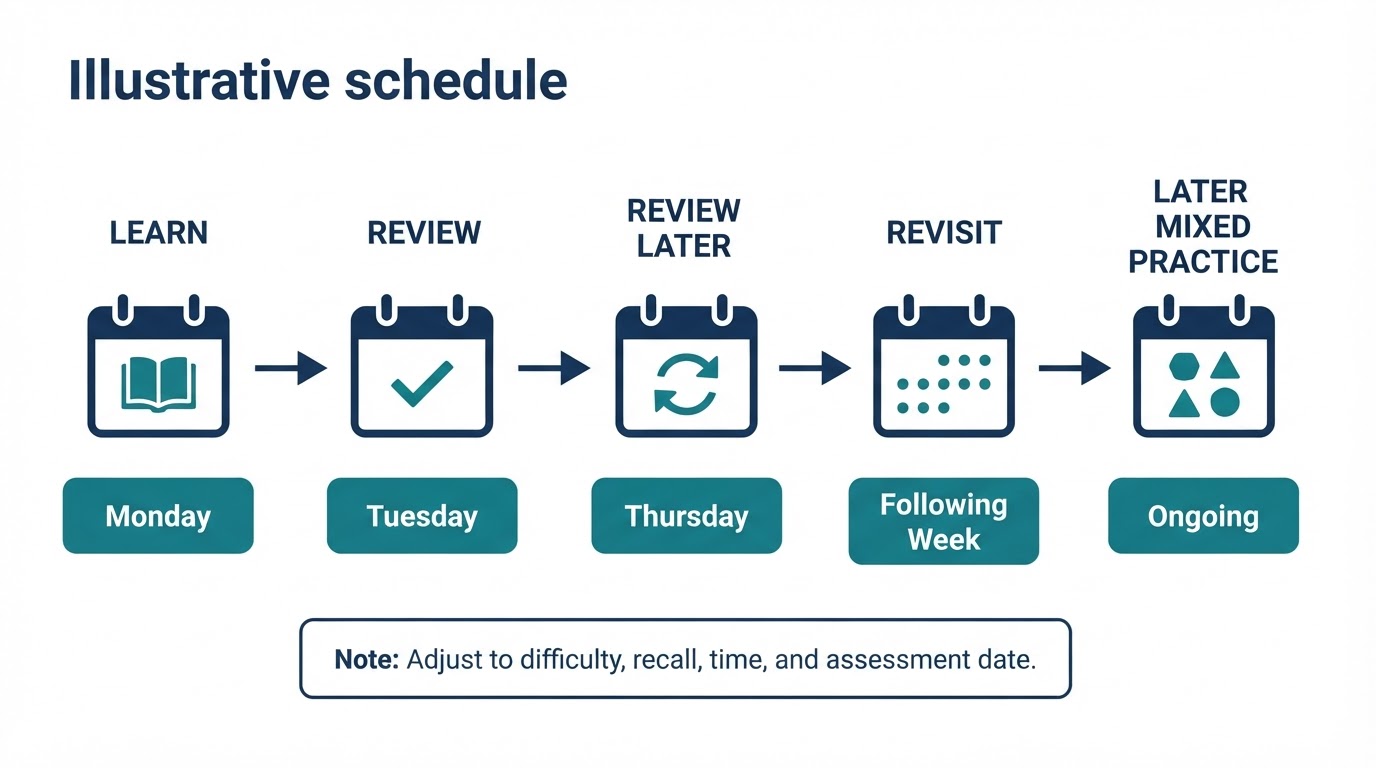
Together, they create a practical learning routine. First build enough understanding to work with the material. Then try to retrieve it without looking, check and correct your response, and review it again after a delay. The interval can be adjusted according to your performance, the difficulty of the material, and the date of an assessment.
You do not need a particular app. Paper cards, a notebook, a calendar, a spreadsheet, or a digital scheduler can all support the method. The essential ingredients are useful questions or tasks, genuine attempts, accurate feedback, and a review schedule you can maintain.
Active Recall and Spaced Repetition: What Is the Difference?
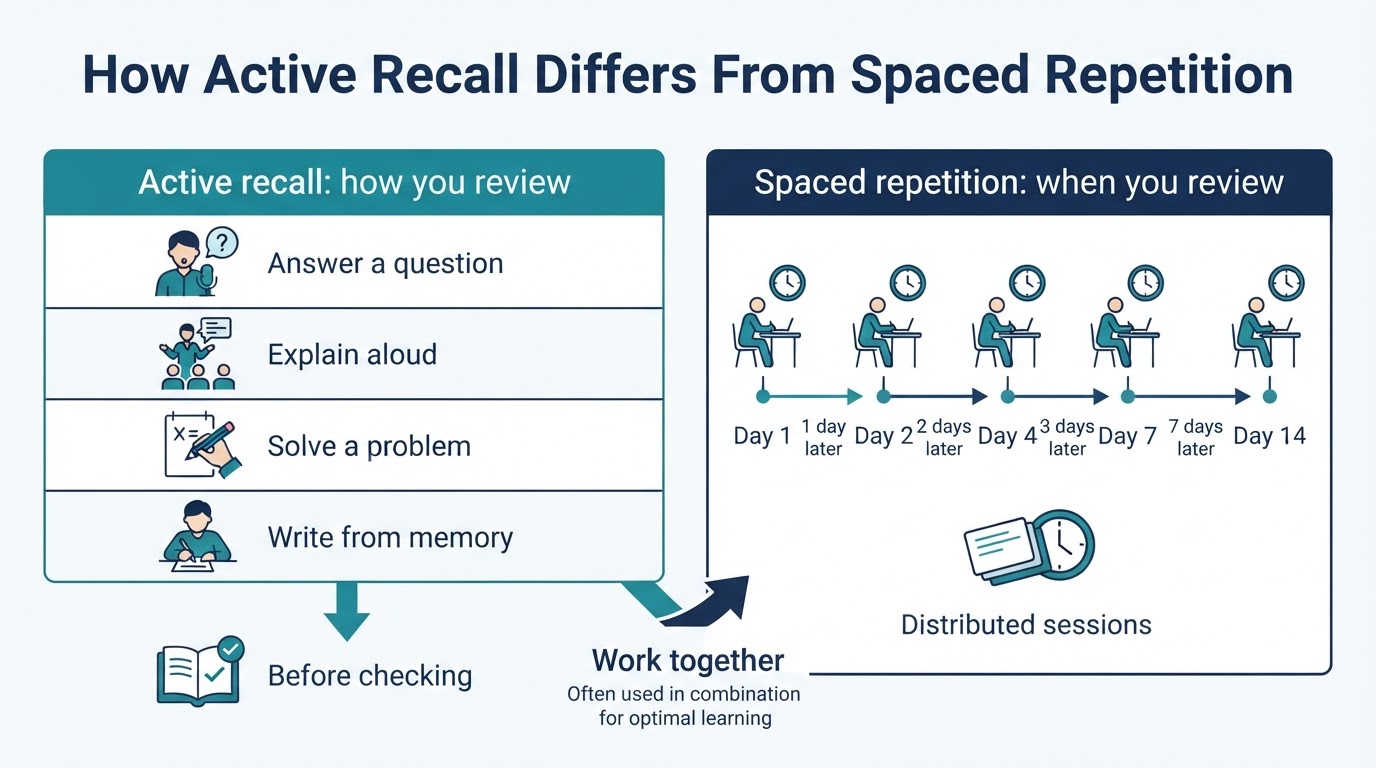
The simplest distinction is this: active recall describes how you review, while spacing describes when you review.
Active recall means deliberately producing information from memory before looking at the answer. You might explain a concept aloud, solve a problem, write what you remember on a blank page, or answer a question before checking your notes.
Spaced repetition is commonly used as a retrieval-focused form of distributed or spaced practice. It involves returning to material across separated sessions rather than massing all practice together. In some digital systems, the term also refers to software that schedules reviews. The broader learning principle does not require an app, and not every form of distributed practice uses an adaptive algorithm.
These approaches are complementary rather than competing techniques. Retrieval gives each review an active task, while spacing distributes those retrieval opportunities over time.
Why Retrieval Practice and Spacing Can Help
Learning-science reviews commonly identify practice testing and distributed practice as useful approaches in many study situations. Retrieval can support later retention rather than merely measure what you already know. However, the size and reliability of any benefit depend on factors such as the material, feedback, timing, question format, learner, and final task.
Remembering a definition is different from applying a principle to an unfamiliar problem. Both may require retrieval, but they need different types of practice. Retrieval can also feel more difficult than rereading. That difficulty is not necessarily evidence that the method is failing, while the ease of rereading is not proof that you can recall or use the information later.
These methods are useful tools, not guarantees of a particular grade, a fixed percentage improvement, permanent memory, or dramatically shorter study time.
A Practical Active Recall and Spaced Repetition Workflow
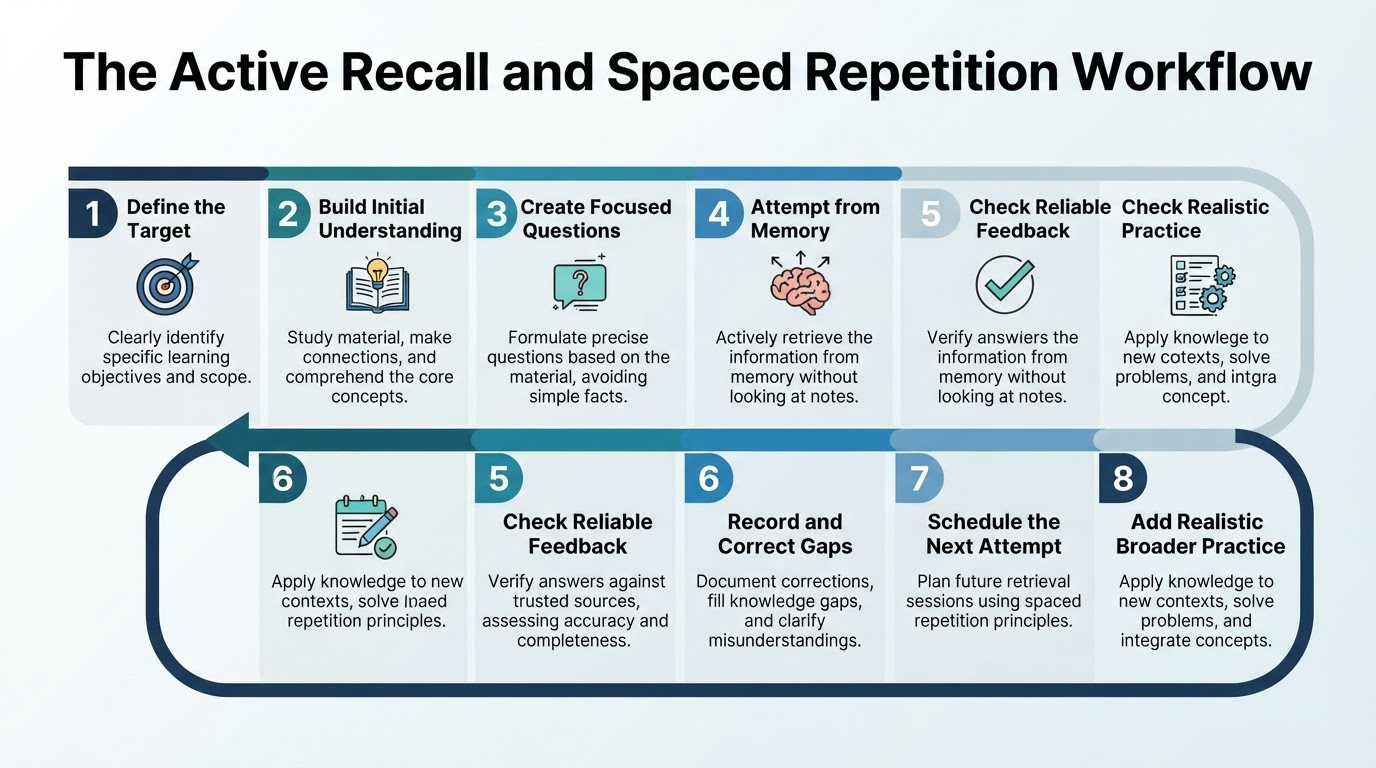
Use the following workflow for school subjects, professional learning, certification preparation, or independent study:
- Define the target. Decide what you need to remember, explain, solve, produce, or perform.
- Build initial understanding. Read a lesson, attend a class, watch a demonstration, or study a worked example.
- Convert important material into focused questions or tasks.
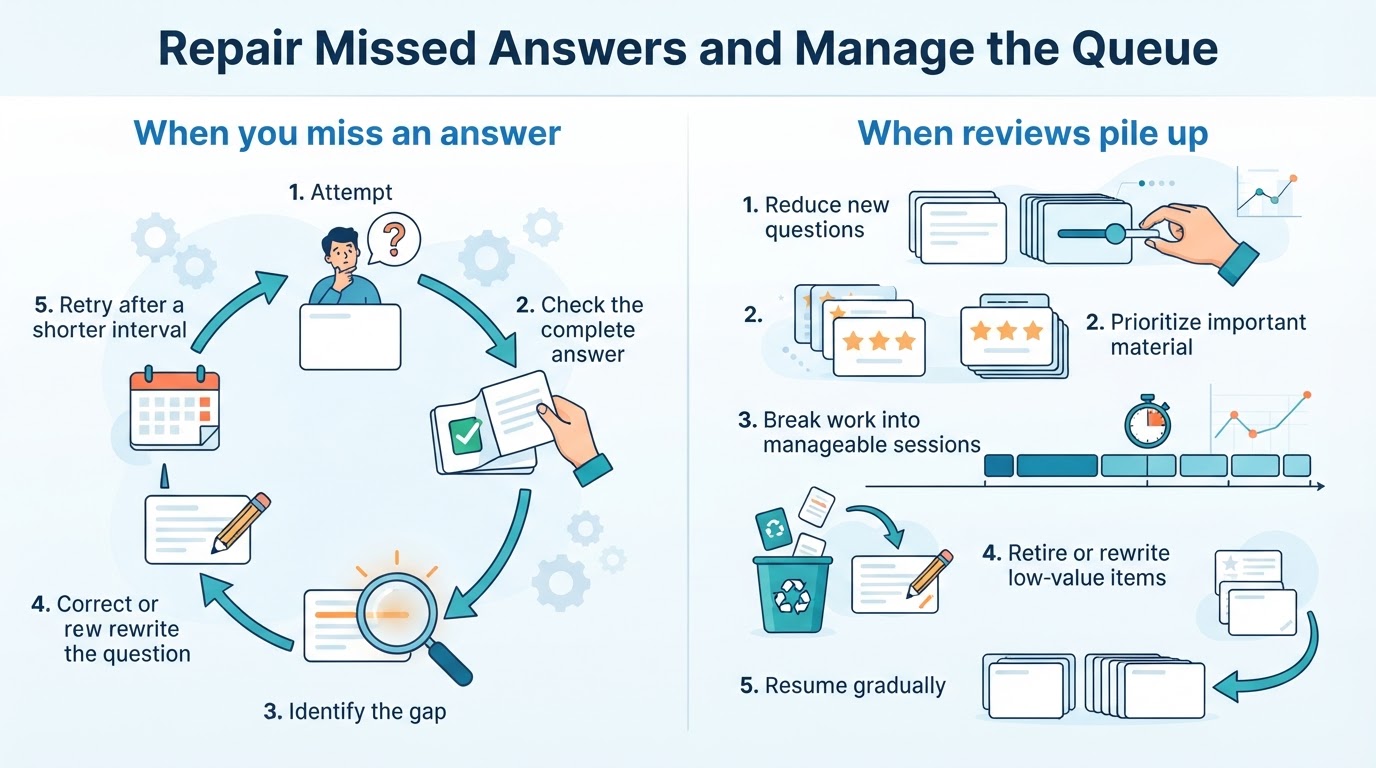
- Attempt each question before checking the answer.
- Compare your response with a reliable textbook, lesson, reference, or answer key.
- Record the correction and identify anything you could not produce.
- Schedule the next attempt after a delay.
- Adjust future reviews according to performance, difficulty, available time, and the assessment date.
- Add broader practice such as mixed topics, varied problems, explanations, written responses, or simulations.
The final step matters because a collection of correct flashcard answers does not necessarily show that you can use the knowledge in a realistic situation.
How to Create Better Active-Recall Questions
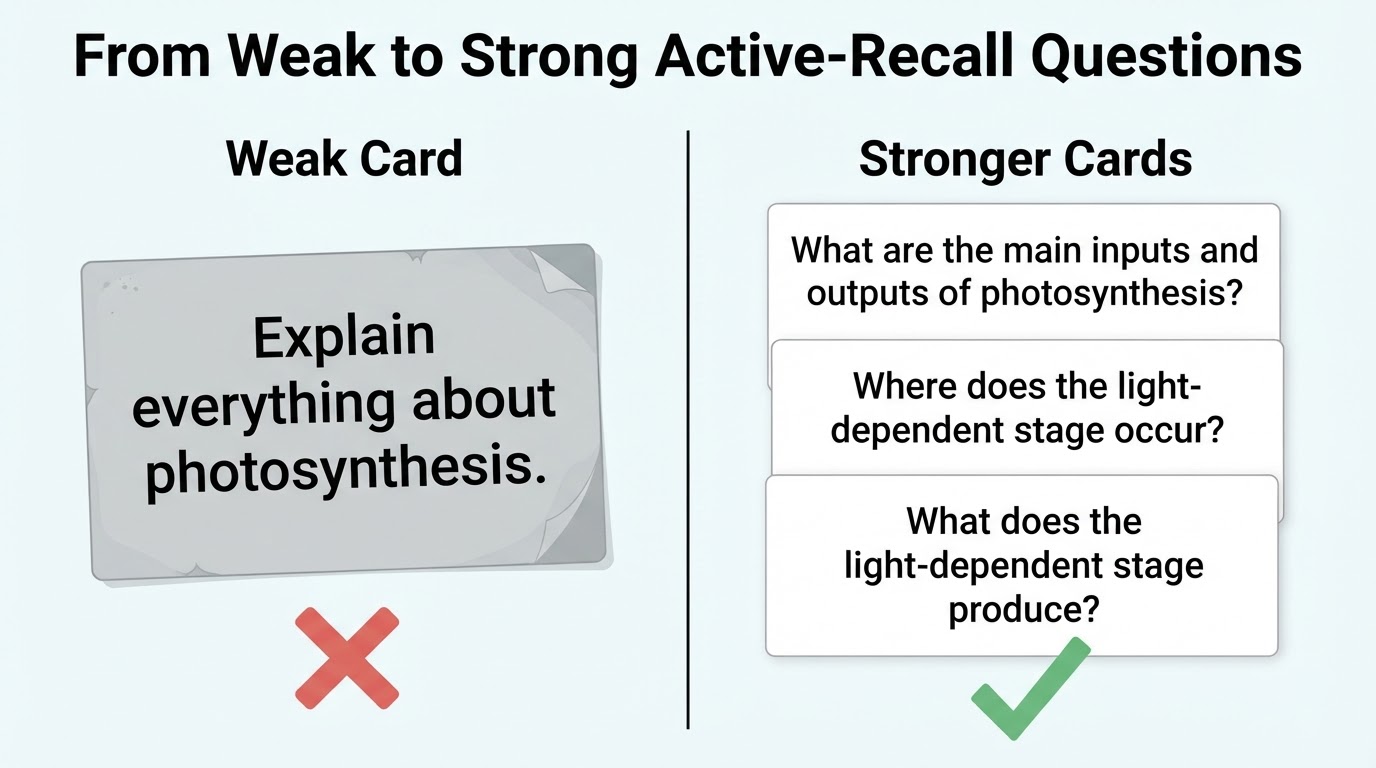
Effective questions require a useful response without becoming so broad that self-assessment is impossible. Start with important ideas, processes, relationships, and applications instead of copying every sentence from your notes.
Where possible, use one clear task per card or worksheet row. Include enough context to make the question meaningful, but do not place the answer in the wording. Keep responses manageable enough to judge accurately, adding an explanation when a single word would hide an important distinction.
Check each answer against a reliable source before adding it to a review routine. Well-designed formatting cannot compensate for an incorrect source note.
Choose the Retrieval Format for the Material
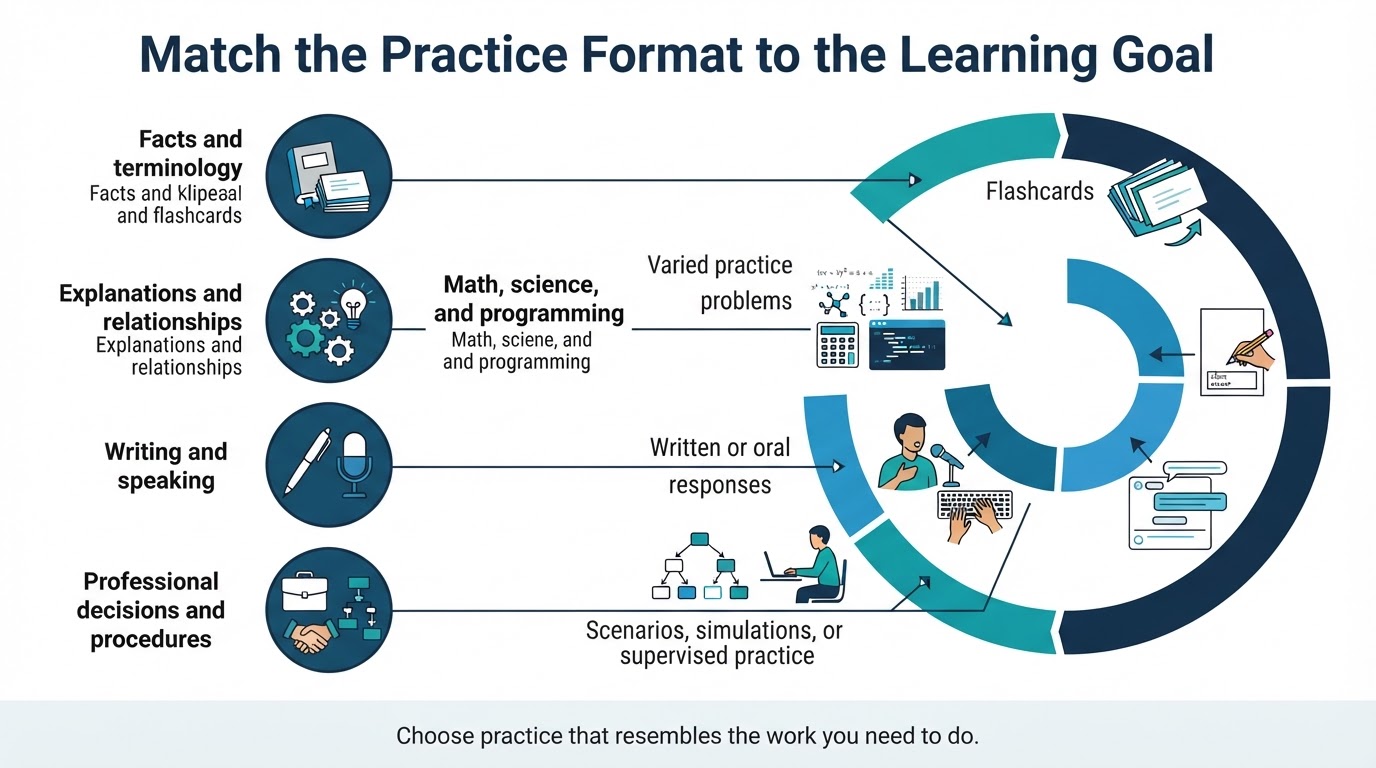
Flashcards are useful, but they are not a complete solution for every subject. Choose practice that resembles the work you eventually need to do.
- Use flashcards for discrete facts, terminology, symbols, formulas, and vocabulary.
- Use short-answer or blank-page recall for explanations, relationships, and larger concepts.
- Use practice problems for mathematics, science, programming, and quantitative work.
- Use oral explanations, written responses, and essays when the final task requires communication.
- Use scenario questions and simulations for professional procedures, certification learning, and decision-making.
- Use realistic practice tests when timing, question format, application, or mixed-topic performance matters.
Some procedural or professional competencies also require demonstration, observation, feedback, or supervised practice. Self-testing and flashcards cannot by themselves validate every practical skill.
Spaced Repetition Without an App
A low-technology system can support the same basic workflow as a digital scheduler. The best choice is the one that makes it easy to create accurate questions, attempt answers, record corrections, and return to material consistently.
Paper cards and genuinely local, offline files can avoid sending study content to a study-service provider. However, privacy depends on device settings, synchronization, backups, and connected applications. A local document that is automatically synchronized to a cloud account is not the same as a document kept offline.
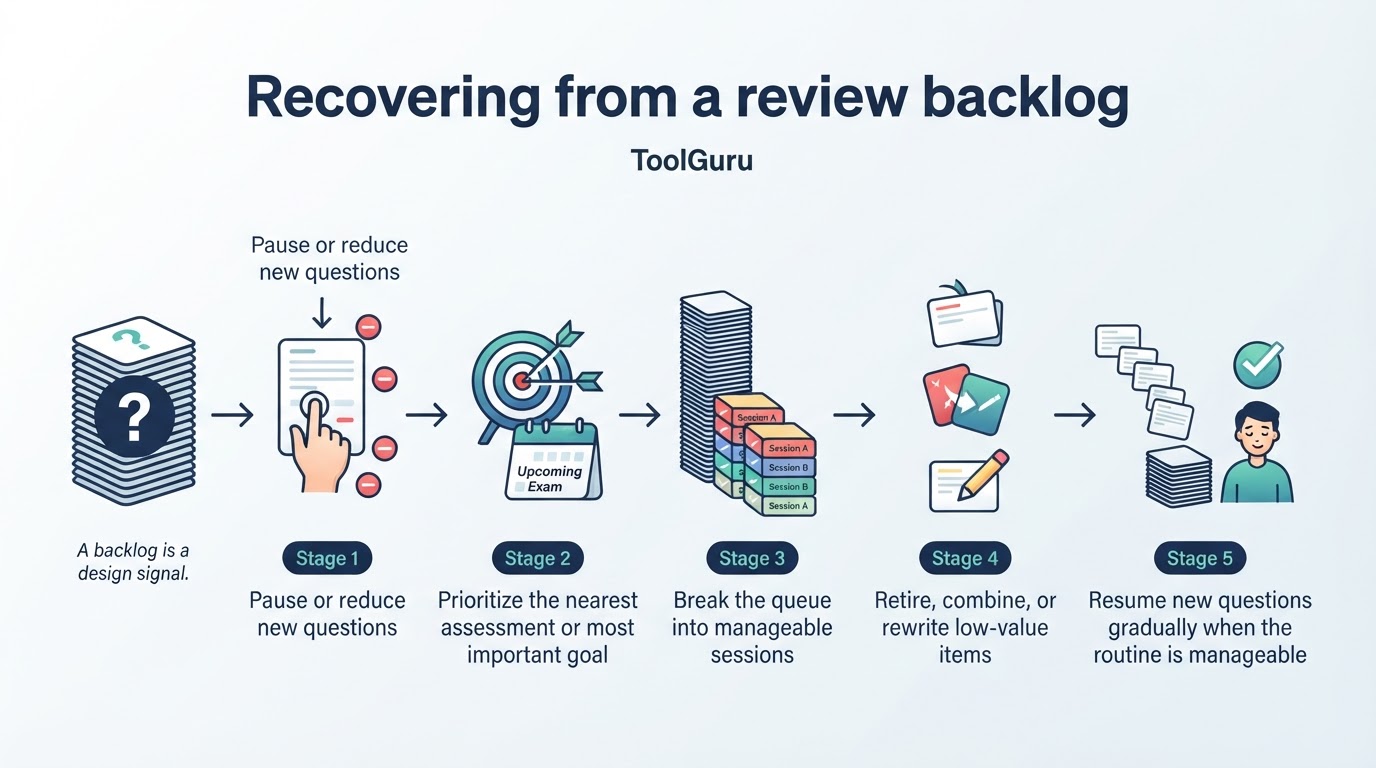
Whatever system you choose, control the number of new questions. Adding material faster than you can review it creates a growing queue. Track the question, your response, the correction, and the next review date.
Limits, Privacy, and Common Mistakes
Active recall and spaced repetition are study methods, not complete replacements for explanation, deliberate practice, feedback, or supervised performance. Avoid these common mistakes:
- Using retrieval before gaining enough initial understanding
- Looking at the answer without making an attempt
- Treating familiarity as proof of mastery
- Relying only on multiple-choice questions when free production is required
- Using flashcards alone for writing, speaking, calculation, practical performance, or unfamiliar applications
- Creating too many new items before establishing a sustainable routine
- Following a rigid schedule without considering difficulty, performance, available time, and assessment deadlines
Evidence and Terminology
The distinction between active recall and spaced review is consistent with educational guidance from Birmingham City University and SafetyCulture/Mitti. These sources describe retrieval as producing information from memory and spacing as distributing reviews across time. A learning-science summary from Examo also emphasizes matching practice to the intended performance and avoiding the assumption that one schedule suits every learner.
These references support the article's practical framework, but they do not establish a universal schedule or guarantee a specific outcome. Evidence for retrieval and distributed practice should be interpreted in light of the material, learner, feedback, timing, and final task.
Further reading:
- Birmingham City University, "Spaced repetition and the 2357 method": https://www.bcu.ac.uk/exams-and-revision/best-ways-to-revise/spaced-repetition
- SafetyCulture/Mitti, "How to learn with active recall and spaced repetition": https://training.safetyculture.com/blog/how-to-use-active-recall-and-spaced-repetition/
- Examo, "Active Recall and Spaced Repetition: The Science of Studying Less and Remembering More": https://examo.ai/blog/active-recall-spaced-repetition-guide
Conclusion
Active recall and spaced repetition work best as a coordinated system. Use active recall to require genuine retrieval, and use spacing to distribute that retrieval across time.
Start with enough understanding to create accurate questions. Attempt the answer before checking it, use feedback to correct gaps, and adjust future reviews according to performance rather than following a rigid schedule. Match the practice format to your goal: flashcards can support facts and terminology, while explanations, problems, writing, speaking, simulations, and realistic tests are essential for broader performance.