
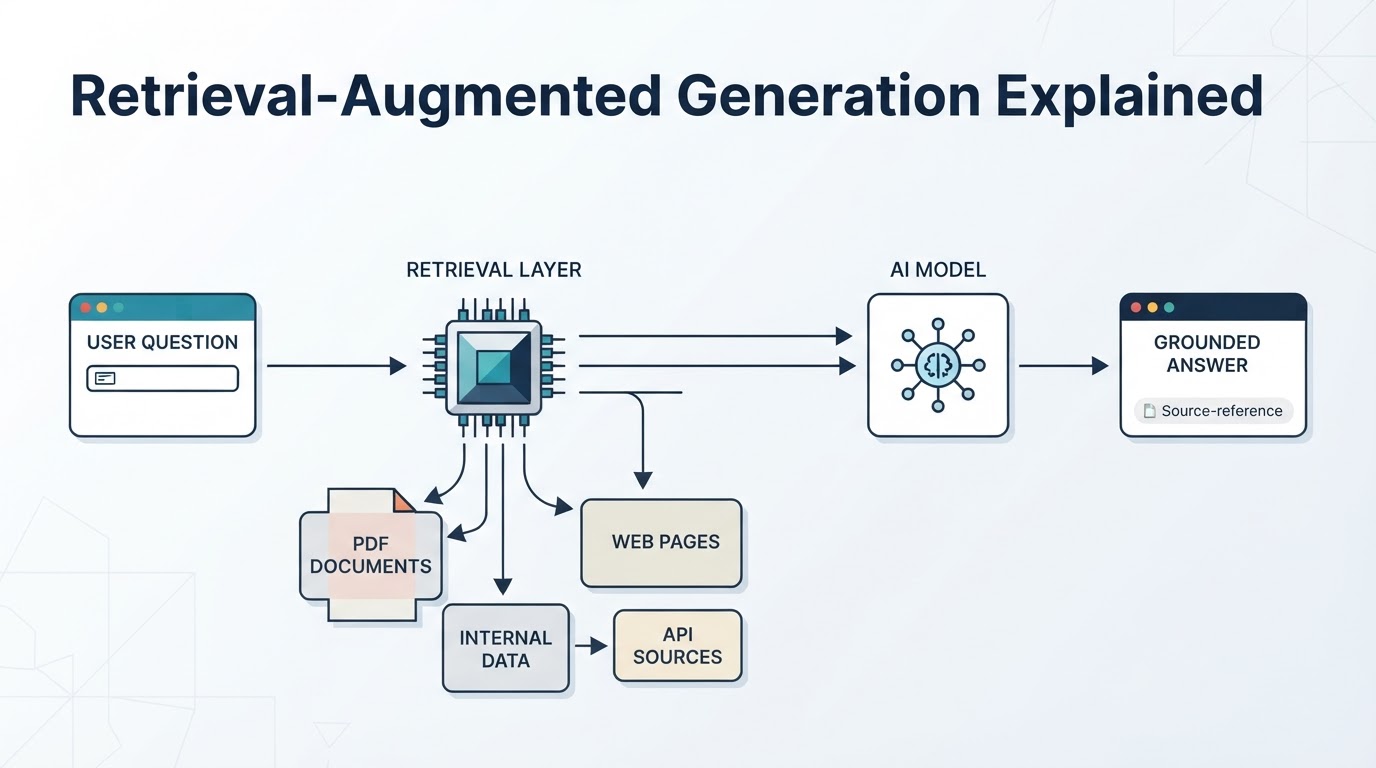
Retrieval augmented generation, usually written as retrieval-augmented generation or RAG, is a method for giving a generative AI application relevant external context at the time a question is answered. The application retrieves information from a managed source, adds that information to the model's context, and generates a response based on the question and retrieved material.
RAG is useful for private, specialized, large, or frequently updated information. A company might use it to answer questions about approved internal policies, while a student might use it to find a deadline in a course handbook. The retrieved material may be new to the application or separately managed, but it can also overlap with information already represented in the model's training data.
RAG can improve grounding and make answers easier to check, but it does not guarantee accuracy or eliminate hallucinations. Results depend on source quality, document processing, retrieval, permissions, instructions, and the model's interpretation of the evidence.
What Is Retrieval-Augmented Generation?
RAG combines information retrieval with text generation. It is an application architecture or workflow, not one specific model, database, or product.
The name describes three stages:
- Retrieval: finding relevant information from approved sources.
- Augmentation: adding that information to the model's context.
- Generation: producing a natural-language response.
A simple example is a student asking, "What is the final assignment deadline?" The application searches the course handbook, retrieves the relevant passage, and asks the model to answer using that passage. If the application retains reliable page and section metadata, it may also show a source reference. Citations are optional application features, however, and require accurate metadata and citation mapping to be trustworthy.
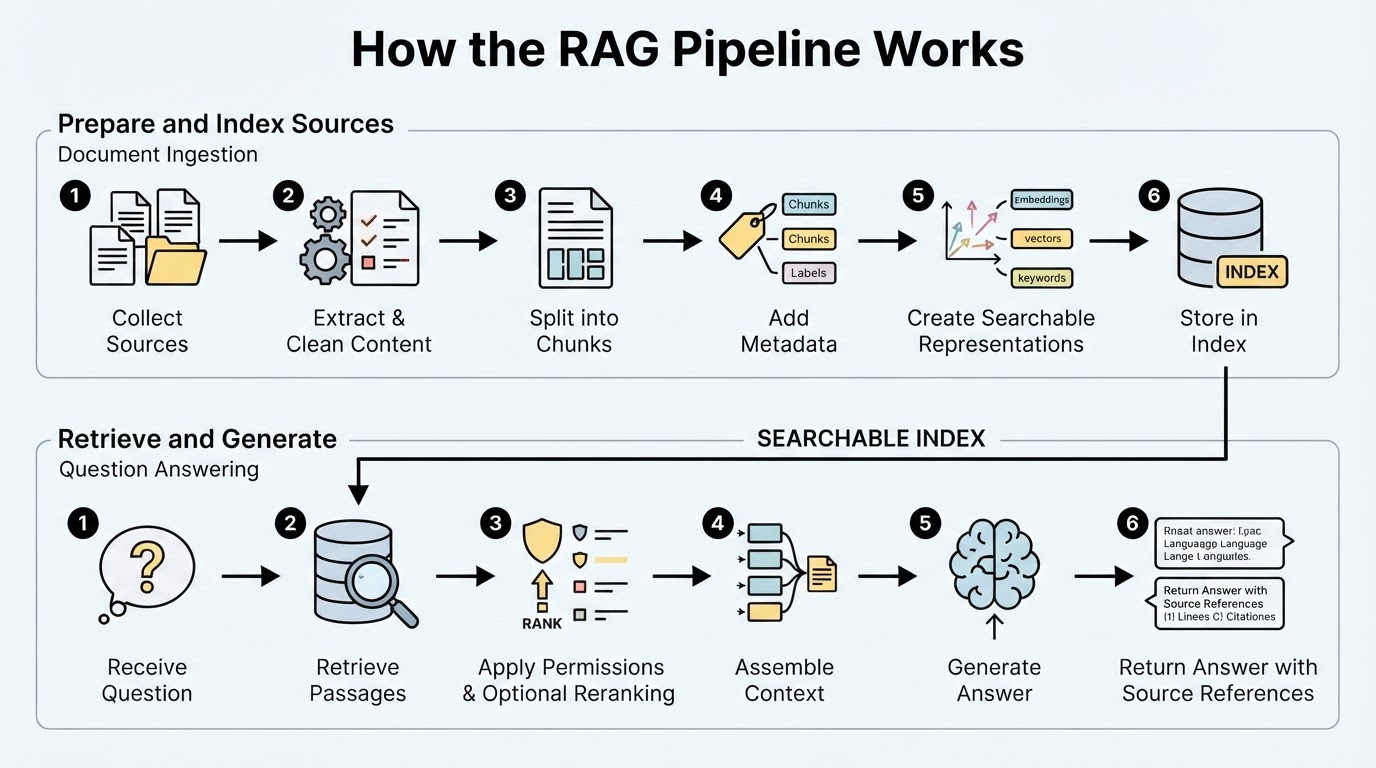
How a Typical RAG Pipeline Works
A baseline RAG pipeline has two related parts: preparing and indexing source material, then retrieving and using it for each question. Production systems may add query rewriting, routing, caching, access-control checks, monitoring, fallback searches, human review, or post-generation validation.
A Practical RAG Example: Finding a Deadline in a PDF
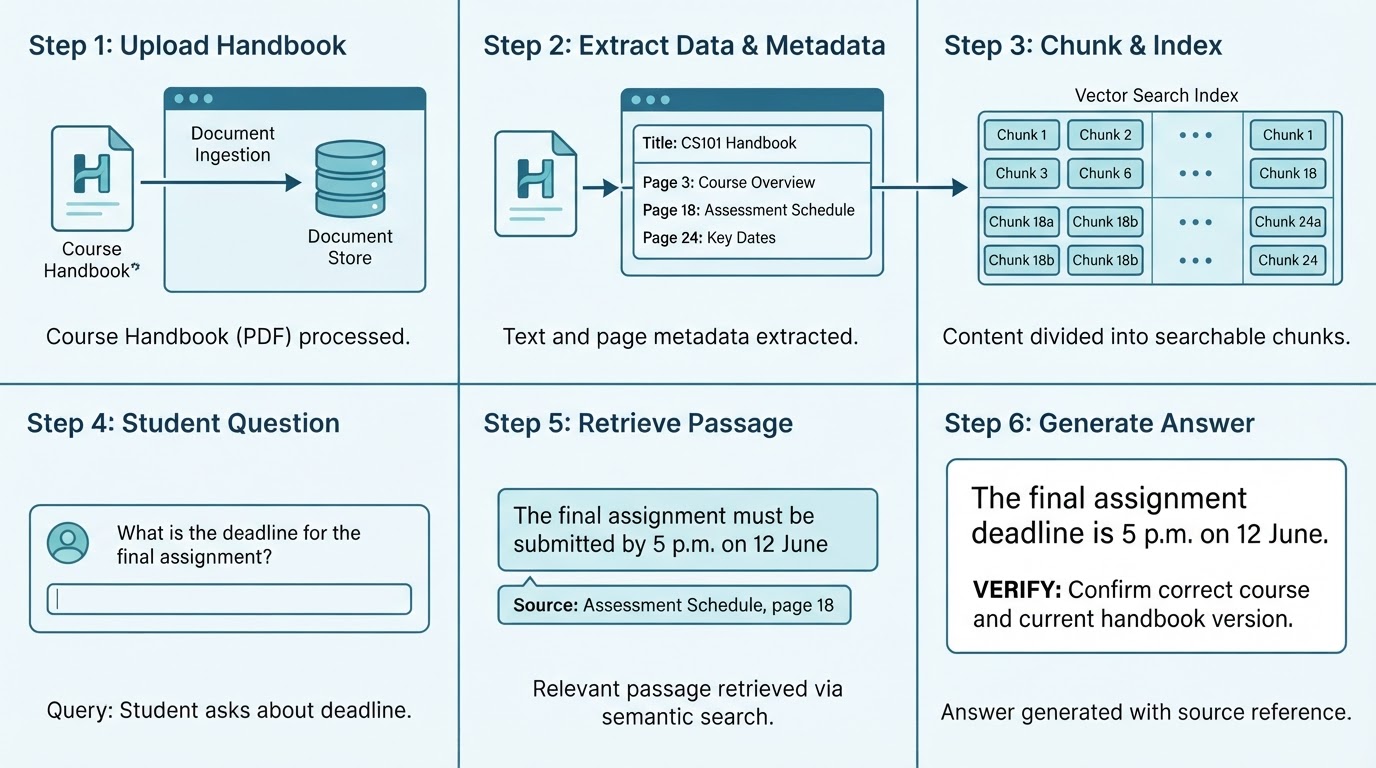
Consider a course handbook containing several assessment dates.
- The application extracts text from the handbook and preserves page and section information.
- It divides the content into chunks and indexes them with metadata such as the document version and page number.
- A student asks, "What is the deadline for the final assignment?"
- Retrieval returns a passage such as: "The final assignment must be submitted by 5 p.m. on 12 June. See Assessment Schedule, page 18."
- The application supplies the question and passage to the model.
- The generated answer might be: "The final assignment is due by 5 p.m. on 12 June. The relevant information appears in the Assessment Schedule on page 18."
The answer is useful because the relevant passage was retrieved and the source location was retained. It is not automatically reliable: the user should still confirm that the passage belongs to the correct course and current handbook version. If the application does not preserve page metadata or map citations correctly, it should not imply that a page reference is guaranteed.
RAG Compared With Prompting, Search, and Fine-Tuning
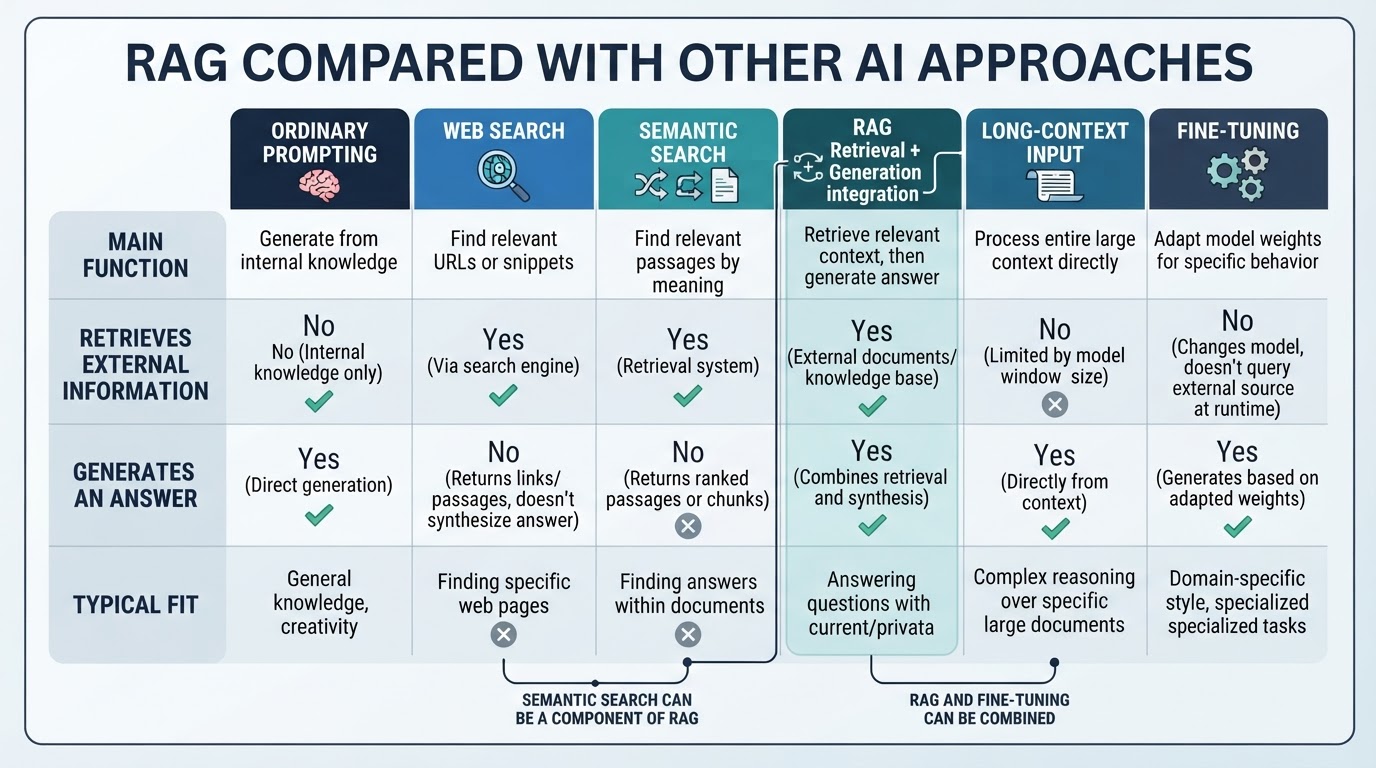
RAG is related to several other techniques, but they solve different problems.
Common RAG Use Cases
RAG can support applications that need controlled access to information that is private, specialized, large, or frequently updated. These are potential applications, not guarantees of performance.
RAG Limitations: Accuracy, Hallucinations, and Conflicts
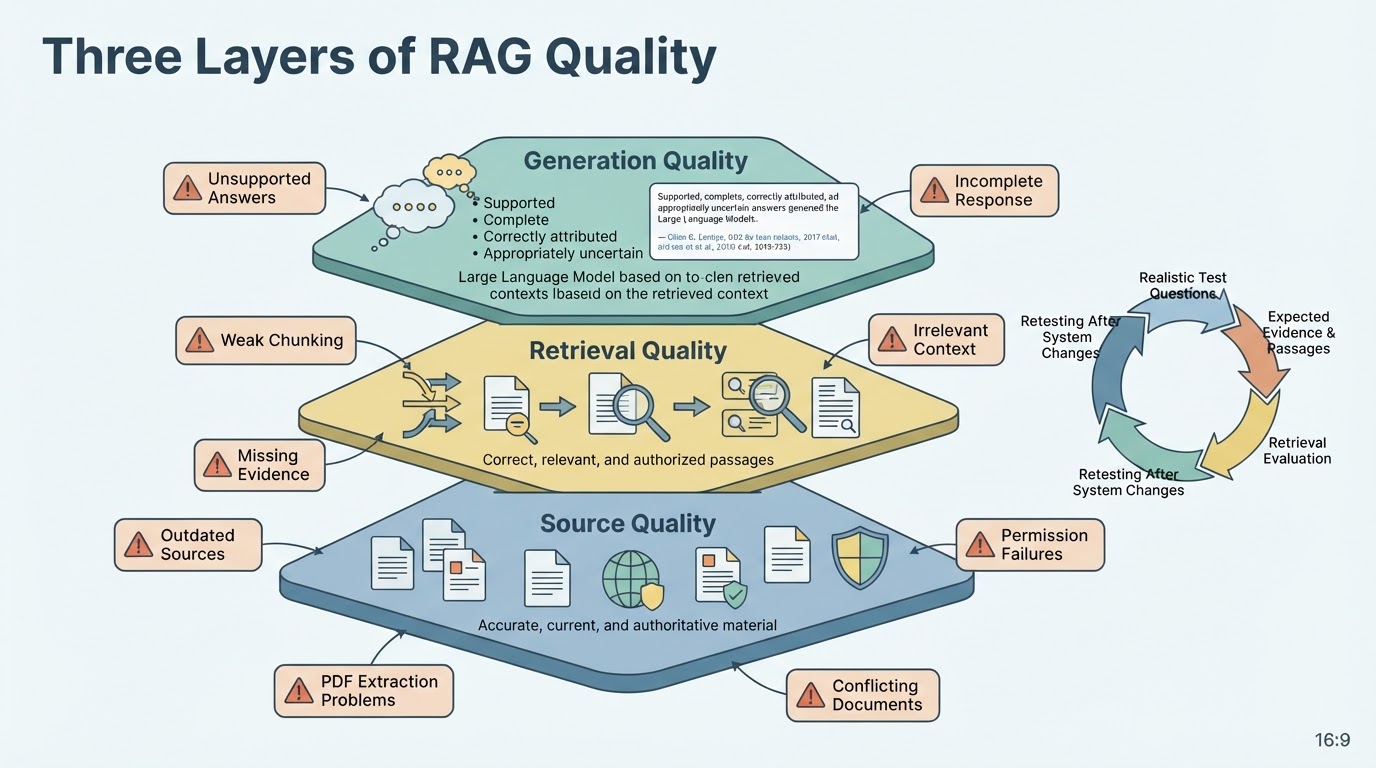
RAG may reduce unsupported or outdated responses by supplying relevant evidence, but it does not eliminate hallucinations or guarantee factual accuracy. Errors can originate in the source, extraction, chunking, retrieval, permissions, instructions, or final generation.
A robust application should allow the model to say that the available sources do not contain enough information. It should also identify conflicting documents instead of silently presenting one source as certain. Retrieved text should be treated as source material, not automatically trusted instructions; even an internally approved document can contain outdated, misleading, or instruction-like content.
Privacy, Permissions, and Security
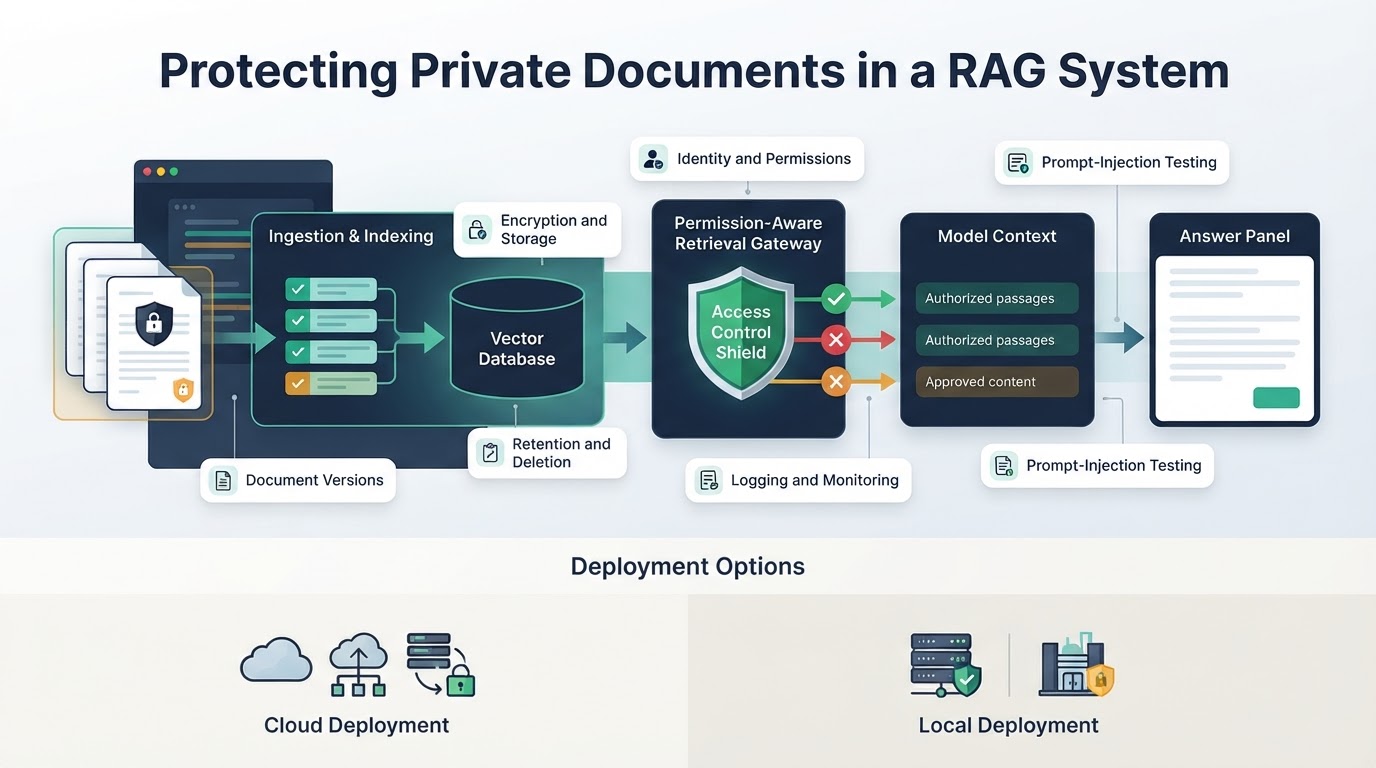
Private-document RAG is not automatically private or secure. Depending on the deployment, content may pass through ingestion, extraction, embedding, storage, retrieval, logging, and model services. The exact data practices vary by provider and architecture.
Before using confidential material, review the applicable provider and service documentation. Check retention, deletion, logging, encryption, processing location, administrator access, training use, subprocessors, and backup practices. Do not assume that HTTPS, cloud hosting, or local deployment by itself guarantees privacy.
Permission-aware retrieval is an essential control: unauthorized passages should be blocked before they reach the model. It is not a complete authorization or data-loss-prevention system. Identity management, storage controls, logging, monitoring, and security testing are also required.
Local or self-hosted RAG may reduce dependence on sending content to an external service, but it still requires secure storage, access controls, backups, updates, monitoring, and careful operations. Retrieved documents should be treated as untrusted data and tested for prompt injection, data-exfiltration attempts, misleading instructions, and unauthorized cross-document access.
When Should You Use RAG?
Consider RAG when an application must answer questions using private, specialized, controlled, or frequently updated information, especially when the collection is too large to place directly into every request.
Use ordinary prompting when the information is short and stable. Use search when the main goal is to locate documents or pages. Consider long-context input when a manageable collection must remain broadly available to the model. Consider fine-tuning when the main need is consistent behavior, formatting, style, or a specialized transformation.
RAG may be a poor choice when source quality is unreliable, permissions cannot be enforced, or retrieval cannot be evaluated. Adding a retrieval layer does not turn an unreliable collection into a trustworthy knowledge system.
Further Reading
For technical background, see IBM's overview of RAG at https://www.ibm.com/think/topics/retrieval-augmented-generation, AWS's explanation at https://aws.amazon.com/what-is/retrieval-augmented-generation/, and Google Cloud's discussion of RAG and factual accuracy at https://cloud.google.com/use-cases/retrieval-augmented-generation. These explain the general architecture; implementation details vary by system and provider.
Conclusion
Retrieval augmented generation connects a generative application to external context through retrieval and generation. It can help answer questions about private documents, specialized references, databases, APIs, and changing information without retraining the underlying model for every update.
The practical takeaway is that RAG quality depends on the entire system: reliable sources, accurate extraction, suitable retrieval, permissions, clear instructions, evaluation, and maintenance. RAG can improve grounding, but important answers should still be checked against the underlying evidence.